Have you ever opened Instagram, YouTube, or TikTok just to check one thing, only to suddenly realize that 30 minutes have passed? You’re not alone. Endless scrolling has become a normal part of everyday life, but it isn’t simply because we lack self-control. There’s an interesting psychology behind why we keep coming back to our screens.
One of the biggest reasons we keep scrolling is unpredictability. You never know what the next post or video will show. It could be funny, surprising, useful, emotional, or completely unexpected. That uncertainty creates curiosity and makes your brain want to find out what comes next. It’s similar to why we keep checking notifications or refreshing a feed—the possibility of discovering something interesting keeps us coming back.
This is also connected to something called variable rewards. When every scroll gave you exactly the same type of content, you would probably get bored quickly. Instead, some posts are ordinary while others are highly entertaining or surprising. Because you don’t know when the next interesting piece of content will appear, you keep scrolling in anticipation of that next reward.
Another reason is that our brains enjoy quick rewards. Every interesting video, funny meme, useful tip, or surprising post can give us a small moment of satisfaction. Because new content appears so quickly, there is always another opportunity to experience that feeling. This can make it surprisingly difficult to put the phone down, even when we originally planned to scroll for only a few minutes.
The endless nature of social media also plays an important role. A book has a final page, a movie has an ending, and a television episode eventually finishes. Social media feeds often have no clear stopping point. When you reach the bottom, another video or post simply appears. Without a natural ending, it becomes easy to think, “Just one more.” Before you know it, one more can turn into twenty.
Modern platforms also use personalized recommendation systems to keep showing content that matches your interests. The more you interact with certain types of posts, the better the platform can predict what you might want to watch next. This can make your feed feel increasingly relevant, making it even harder to leave.
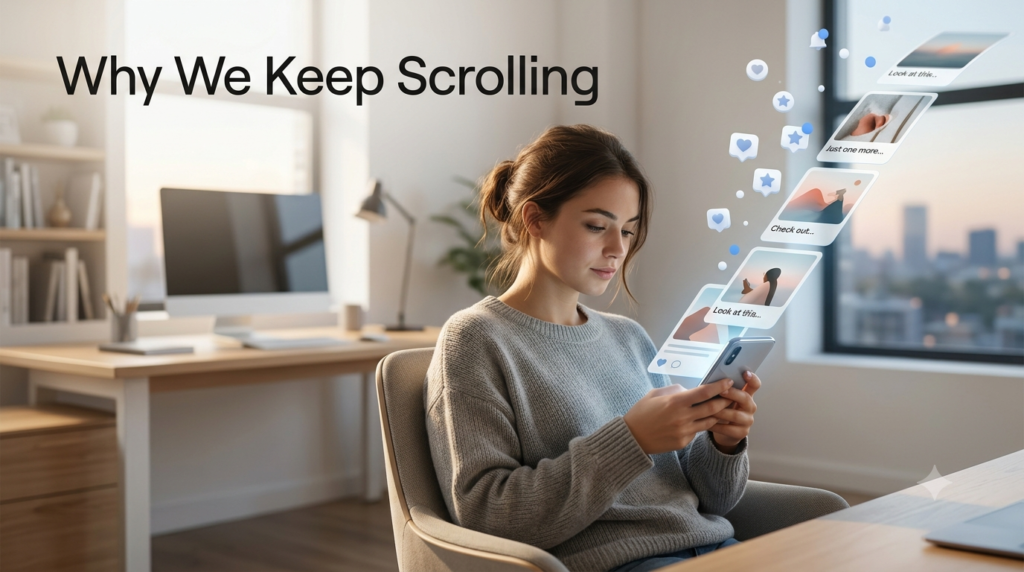
Scrolling can also become our automatic response to boredom. Waiting for food, standing in a queue, sitting alone, or simply having a few free seconds can trigger the habit of reaching for our phones. Over time, we may start scrolling without even consciously deciding to do it. The phone becomes part of a simple habit loop: boredom or a notification → open the app → scroll → receive an interesting reward → repeat.
The good news is that you don’t have to delete every social media app to break the habit. Small changes can help, such as turning off unnecessary notifications, keeping your phone away while working, setting app limits, or replacing scrolling with another short activity. You can also pause and ask yourself, “Did I actually come here for something, or am I just scrolling?” That simple question can help interrupt the automatic habit.
Endless scrolling isn’t just about poor discipline. It is connected to curiosity, unpredictable rewards, personalized content, boredom, and habit formation. Understanding these factors can make it easier to recognize why we keep scrolling and take back control of our attention.
So, the next time you tell yourself, “I’ll scroll for just five minutes,” remember that your brain may simply be waiting to discover what comes next. Sometimes, the hardest part of scrolling isn’t starting—it’s knowing when to stop.